
Learn Python recursion with simple examples, syntax, advantages, disadvantages, recursion vs loops, and real-world use cases. Beginner-friendly guide with code examples.
Python Recursion Explained with Simple Examples
Python Recursion is one of the most important programming concepts every beginner should understand. It is widely used in algorithms, data structures, problem-solving, artificial intelligence, and competitive programming.
If you are learning Python, recursion may initially look confusing, but once you understand the logic, it becomes simple and powerful.
In this guide, you will learn:
- What recursion is in Python
- How recursion works
- Base case and recursive case
- Simple recursion examples
- Real-world use cases
- Advantages and disadvantages
- Recursion vs loops
- Best practices
By the end of this article, you will clearly understand Python Recursion with practical examples.
What is Python Recursion?
Python Recursion is a programming technique where a function calls itself repeatedly until a specific condition is met.
In simple words:
A recursive function solves a problem by breaking it into smaller versions of the same problem.
A recursive function contains:
- A base case
- A recursive call
Without a base case, recursion will continue forever and cause an error.
How Recursion Works
Let’s understand recursion step by step.
Suppose a function calls itself:
def hello():
print(“Hello”)
hello()
This function will run infinitely because there is no stopping condition.
To stop recursion, we use a base condition.
Basic Syntax of Recursion
def function_name():
# Base condition
if condition:
return value
# Recursive call
function_name()
The function keeps calling itself until the condition becomes true.
Base Case in Recursion
The base case is the most important part of recursion.
It stops the recursive calls.
Example:
def countdown(n):
if n == 0:
print(“Done”)
return
print(n)
countdown(n – 1)
countdown(5)
Output:
5
4
3
2
1
Done
Explanation:
- Function starts with 5
- Calls itself with smaller numbers
- Stops when n becomes 0
Simple Recursion Example
Let’s create a simple recursive function.
def greet(count):
if count == 0:
return
print(“Welcome”)
greet(count – 1)
greet(3)
Output:
Welcome
Welcome
Welcome
Here:
- Function calls itself repeatedly
- Count decreases every time
- Stops at 0
Factorial Program Using Recursion
Factorial is one of the most popular recursion examples.
Formula
n!=n×(n−1)!n! = n \times (n-1)!n!=n×(n−1)!
Example:
5! = 5 × 4 × 3 × 2 × 1
Result:
120
Python Program
def factorial(n):
if n == 1:
return 1
return n * factorial(n – 1)
print(factorial(5))
Output:
120
Step-by-Step Flow
factorial(5)
= 5 * factorial(4)
= 5 * 4 * factorial(3)
= 5 * 4 * 3 * factorial(2)
= 5 * 4 * 3 * 2 * factorial(1)
= 5 * 4 * 3 * 2 * 1
= 120
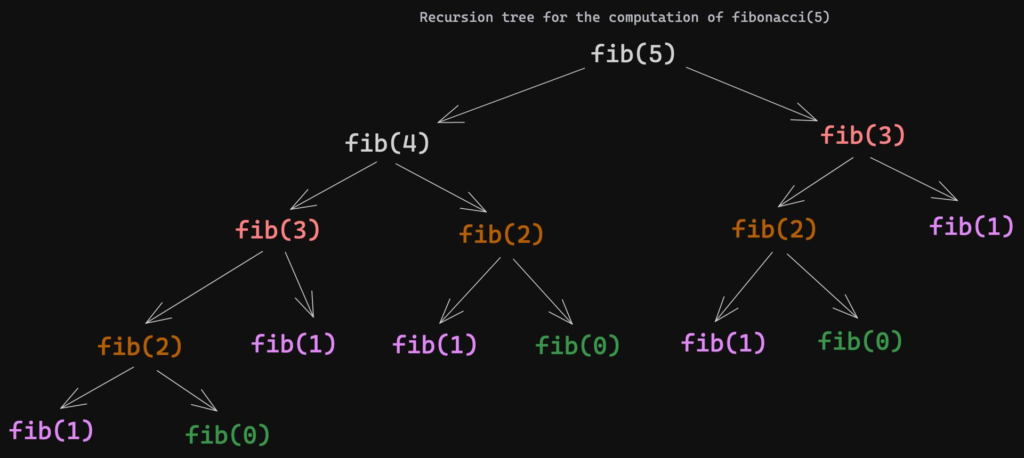
Fibonacci Series Using Recursion
The Fibonacci sequence is another famous recursion problem.
Formula
F(n)=F(n−1)+F(n−2)F(n)=F(n-1)+F(n-2)F(n)=F(n−1)+F(n−2)
Sequence:
0 1 1 2 3 5 8 13
Python Program
def fibonacci(n):
if n <= 1:
return n
return fibonacci(n – 1) + fibonacci(n – 2)
for i in range(7):
print(fibonacci(i))
Output:
0
1
1
2
3
5
8
Sum of Numbers Using Recursion
This program calculates the sum of numbers recursively.
Python Program
def total_sum(n):
if n == 1:
return 1
return n + total_sum(n – 1)
print(total_sum(5))
Output:
15
Explanation:
5 + 4 + 3 + 2 + 1 = 15
Reverse a String Using Recursion
Recursion can also reverse strings.
Python Program
def reverse_string(text):
if len(text) == 0:
return text
return reverse_string(text[1:]) + text[0]
print(reverse_string(“Python”))
Output:
nohtyP
Recursion vs Loop
| Feature | Recursion | Loop |
| Technique | Function calls itself | Repeats block of code |
| Speed | Usually slower | Faster |
| Memory Usage | Higher | Lower |
| Readability | Cleaner for complex problems | Better for simple repetition |
| Best For | Trees, graphs, algorithms | Iteration tasks |
Advantages of Recursion
1. Cleaner Code
Recursive solutions are often shorter and easier to understand.
2. Ideal for Complex Problems
Useful for:
- Tree traversal
- Graph algorithms
- Divide-and-conquer algorithms
3. Reduces Code Length
Many complex problems become smaller and simpler.
Disadvantages of Recursion
1. More Memory Usage
Each recursive call uses stack memory.
2. Slower Execution
Recursive functions are usually slower than loops.
3. Risk of Infinite Recursion
Missing a base case causes program crashes.
Real-World Uses of Recursion
Python Recursion is used in many real applications.
File System Navigation
Folders contain subfolders, making recursion useful.
Tree Data Structures
Used in:
- Binary trees
- DOM trees
- Decision trees
Artificial Intelligence
AI algorithms often use recursive approaches.
Backtracking Algorithms
Examples:
- Sudoku Solver
- Maze Solver
- N-Queens Problem
Recursion Depth Error
Python limits recursion depth to prevent crashes.
Example error:
RecursionError: maximum recursion depth exceeded
This happens when recursive calls become too deep.
Check Recursion Limit
import sys
print(sys.getrecursionlimit())
Best Practices for Recursion
Always Use a Base Case
Without it, recursion becomes infinite.
Make Progress Toward Base Case
Each recursive call should move closer to stopping.
Avoid Deep Recursion
Too many recursive calls can cause memory issues.
Use Recursion for Suitable Problems
Not every problem needs recursion.
When Should You Use Recursion?
Use recursion when:
- Problem can be divided into smaller subproblems
- Data structure is hierarchical
- Code readability matters
Avoid recursion when:
- Performance is critical
- Simple loops can solve the problem easily
Iterative vs Recursive Factorial
Recursive Version
def factorial(n):
if n == 1:
return 1
return n * factorial(n – 1)
Iterative Version
def factorial(n):
result = 1
for i in range(1, n + 1):
result *= i
return result
Both produce the same output.
Common Mistakes in Recursion
Missing Base Case
def test():
test()
This causes infinite recursion.
Incorrect Recursive Call
return n + function(n)
The value never changes.
Correct version:
return n + function(n – 1)
Conclusion
Python Recursion is a powerful programming concept that allows functions to call themselves to solve problems.
Although recursion may seem difficult at first, it becomes easy once you understand:
- Base case
- Recursive call
- Problem breakdown
Recursion is widely used in:
- Algorithms
- Data structures
- AI systems
- Tree traversal
- Backtracking problems
Start with simple examples like factorial and Fibonacci, then move to advanced recursive problems.
Mastering Python Recursion will significantly improve your programming and problem-solving skills.
FAQs About Python Recursion
What is recursion in Python?
Recursion is a technique where a function calls itself until a stopping condition is met.
Why is recursion used?
Recursion simplifies complex problems by dividing them into smaller subproblems.
What is a base case?
A base case is the condition that stops recursive calls.
Is recursion better than loops?
Not always. Recursion is cleaner for complex problems, while loops are faster for simple tasks.
What causes RecursionError in Python?
Infinite recursion or too many recursive calls cause RecursionError.
Related Python Tutorials
Python Functions Explained
Python Exception Handling
Python File Handling
NumPy Basics Explained
Useful Resources for Learning Python Loops
If you want to explore Python loops in greater depth, these official resources are highly recommended:
- Python Official Documentation on Loops: https://docs.python.org/3/tutorial/controlflow.html
- Python Official Documentation: https://docs.python.org/3/
- W3Schools Python Loops Tutorial: https://www.w3schools.com/python/python_for_loops.asp
Pingback: Types of Machine Learning Explained: Complete Beginner's Guide (2026) - JitCoder
Pingback: OOP in Python Explained with Examples (2026) - JitCoder